
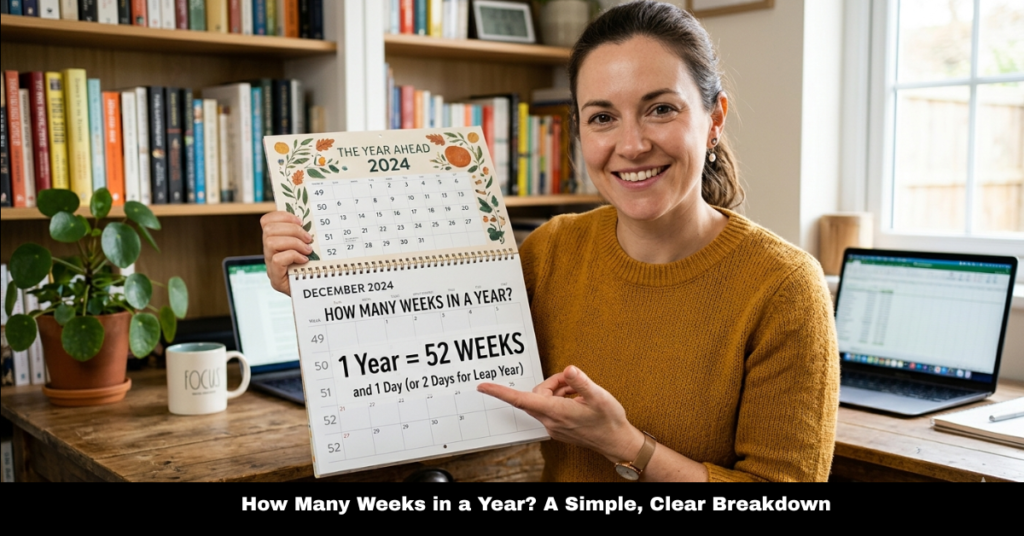

If you’ve ever wondered how many weeks in a year, you’re not alone. It’s one of those simple questions that actually comes up in budgeting, payroll planning, scheduling, and even goal setting.
The short answer is that a standard year has 52 weeks, but the full explanation is a little more interesting than that. In reality, the exact number includes extra days that don’t neatly fit into full weeks.
In this guide, we’ll break everything down in a clear, human way so you fully understand how many weeks in a year and why the answer matters in real life—from work schedules to planning your time better.
How Many Weeks in a Year?
A standard year has:
- 365 days
- 52 weeks
- 1 extra day
Since 1 week = 7 days, dividing 365 by 7 gives us:
- 52 weeks and 1 day
So when people ask how many weeks in a year, the most accurate answer is:
52 weeks and 1 day (in a regular year)
Why a Year Doesn’t Divide Perfectly Into Weeks
The calendar system is based on the Earth’s orbit around the sun, which takes about 365.25 days—not a clean multiple of 7.
That’s why:
- We get 52 full weeks
- Plus extra days left over
- Every 4 years, a leap year adds another day (February 29)
In a leap year:
- 366 days = 52 weeks and 2 days
This small difference is why how many weeks in a year 52 is correct, but not the full picture.
How Many Weeks in a Year 2026?
If you’re specifically wondering about how many weeks in a year 2026, here’s the breakdown:
- 2026 is a common year (not a leap year)
- It has 365 days
- That equals 52 weeks and 1 day
So, in 2026:
You still have 52 full weeks, plus one extra day.
How Many Weeks in a Year for Payroll?
Payroll systems often rely on weekly structures, which makes this question very important.
When calculating salaries:
- 52 weeks = standard yearly payroll cycles
- Some companies use 26 biweekly pay periods
So, in payroll terms:
- How many weeks in a year for payroll? → 52 weeks
- This helps companies plan salaries, taxes, and deductions
How Many Weeks in a Year Biweekly Pay Systems
If you get paid every two weeks, you might wonder about how many weeks in a year biweekly systems cover.
Here’s how it works:
- 1 year = 52 weeks
- Biweekly pay = every 2 weeks
- So: 52 ÷ 2 = 26 pay periods
That’s why:
- You usually get 26 paychecks per year
- Occasionally 27 in some calendar alignments
So how many weeks in a year biweekly systems use = 52 weeks divided into 26 pay cycles
How Many Weeks in a Year and Days?
Let’s make it super simple:
Regular Year:
- 365 days
- 52 weeks
- 1 extra day
Leap Year:
- 366 days
- 52 weeks
- 2 extra days
So how many weeks in a year and days always includes a small remainder beyond 52 full weeks.
How Many Weeks in a Year Without Weekends?
This is a fun one people search for.
A year has:
- 52 weeks
- 104 weekend days (52 Saturdays + 52 Sundays)
So if you remove weekends:
- 365 total days
- 104 weekend days
- = 261 working days (approx.)
So how many weeks in a year without weekends still equals 52 calendar weeks, but fewer working days.
How Many Weeks in a Year and a Half?
Now let’s extend it:
- 1 year = 52 weeks
- Half year = 26 weeks
So:
1.5 years = 78 weeks
That makes how many weeks in a year and a half equal to about 78 weeks total.
How Many Weeks in a Year Left?
This depends on when you’re asking.
For example:
- If 10 weeks have passed in the year:
- 52 – 10 = 42 weeks left
So how many weeks in a year left changes daily based on the current date.
How Many Weeks in a Year Calculator Use
A how many weeks in a year calculator is often used for:
- Payroll planning
- Project timelines
- Study schedules
- Pregnancy tracking
But the calculation is always simple:
Days in year ÷ 7 = weeks in a year
So:
- 365 ÷ 7 = 52.14 weeks
- 366 ÷ 7 = 52.29 weeks
How Many Weeks in a Year Divided by 2
People often ask how many weeks in a year divided by 2 for budgeting or scheduling.
- 52 weeks ÷ 2 = 26 weeks
So half a year equals roughly 26 weeks.
How Many Weeks in a Year for Biweekly Payroll?
This is almost the same as earlier but more specific.
- 52 weeks per year
- Biweekly payroll = every 2 weeks
- So employees receive:
- 26 pay periods per year
So how many weeks in a year for biweekly payroll is always based on 52 weeks.
How Many Weeks in a Year in the World?
Every country using the Gregorian calendar follows the same structure:
- 52 weeks per year globally
- Small variations only come from time zones and calendar systems
So how many weeks in a year in the world is universally:
52 weeks
Summary Table
| Type | Weeks |
|---|---|
| Regular year | 52 weeks + 1 day |
| Leap year | 52 weeks + 2 days |
| Half year | 26 weeks |
| Year and a half | 78 weeks |
| Biweekly payroll cycles | 26 payments |
FAQs
1. How many weeks in a year exactly?
A year has 52 weeks and 1 extra day (2 in a leap year).
2. Why is it not 53 weeks?
Because 365 days is not evenly divisible by 7, so we don’t get a full 53rd week.
3. How many weeks in a year 52 is always correct?
Yes, 52 weeks is the standard approximation used globally.
4. How many weeks in a year biweekly pay systems use?
They use 52 weeks divided into 26 pay periods.
5. How many weeks in a year calculator result?
Most calculators show around 52.14 weeks per year.
Conclusion
Understanding how many weeks in a year is more useful than it seems. While the simple answer is 52 weeks, the real breakdown includes extra days that matter for payroll, planning, and scheduling.
Whether you’re managing finances, setting goals, or tracking work schedules, knowing how a year breaks down helps you stay more organized and efficient.
If you found this helpful, you might want to explore related time and calendar topics to better manage your planning and productivity.